
What is Assessment?
- Assessment is the consistent evaluation of the institution and students’ ability to reach specific, educational goals. It is ultimately about continued and documented improvement!
- Per the Brooklyn College handbook, assessment is defined as: “…an ongoing process through which faculty and staff can appraise student learning and operational effectiveness.”
- Assessment activities are required for accreditation, which the college receives from the Middle States Commission on Higher Education (MSCHE).
Why does Assessment Matter?
- It ensures that the college remain a viable, relevant and engaged institution, for students, faculty and staff.
- It demonstrates that the college is continually improving its programs, teaching, and outreach for the benefit of our students and ourselves.
Assessment – What is Involved?
- To better understand the assessment process, we’ve created the acronym A.P.R.R.
A. – Assess
P. – Process (Data)
R. – Revise (and Implement)
R. – Repeat
Assess: Some form of tool, such as a rubric, should be created to evaluate if specific institutional goals or SLOs are being achieved.
Process: Once the goals or SLOs have been evaluated, the data must be collected, processed, and the results shared with the relevant individuals.
Revise: Based on the data, revisions to institutional offices, programs and/or courses are made.
Repeat: The process is repeated, to ensure that continual improvement is being made.
Administrative, Educational and Student Support (AES) Assessment
- Every AES office must participate in assessment, regardless of whether or not they are student-facing.
- Assessment is conducted on a one to three-year cycle.
- Institutional offices are required to complete an Annual AES Assessment Reporting form.
- SLOs versus operational outcomes
The Three Forms of Academic Assessment
- The three areas for collecting academic assessment data are Pathways courses, assessing individual programs, and a department’s self-study. To help you remember these forms, we’ve created the acronym P.P.S.S.
P. – Pathways
P. – Program
S.S. – Self-Study
Pathways: This assessment applies only to courses designated as a Pathways course. Assessment of these courses, based on their specific categories, occurs on a five-year cycle.
- The categories for Pathways courses are as follows:
- Required Core
- English Composition 1
- Assess 2026 – 2027; 2031 – 2032
- English Composition 2
- Assess 2025 – 2026; 2030 – 2031
- Mathematical and Quantitative Reasoning
- Assess 2023 – 2024; 2028 – 2029
- Life and Physical Sciences
- Assess 2022 – 2023; 2027 – 2028
- English Composition 1
- Flexible Core
- World Cultures and Global Issues
- Assess 2023 – 2024; 2028 – 2029
- U.S. Experience in its Diversity
- Assess 2024 – 2025; 2029 – 2030
- Creative Expression
- Assess 2022 – 2023; 2026 – 2027
- Individual and Society
- Assess 2023 – 2024; 2027 – 2028
- Scientific World
- Assess 2025 – 2026; 2030 – 2031
- World Cultures and Global Issues
- The college’s General Education Assessment Coordinator collaborates with individual chairs to:
- determine a plan for data collection
- select the SLOs to be assessed by specific courses
- finalize/report on the data collected
- Required Core
Table 1.1 – Gen Ed/Pathways Assessment Collection Schedule
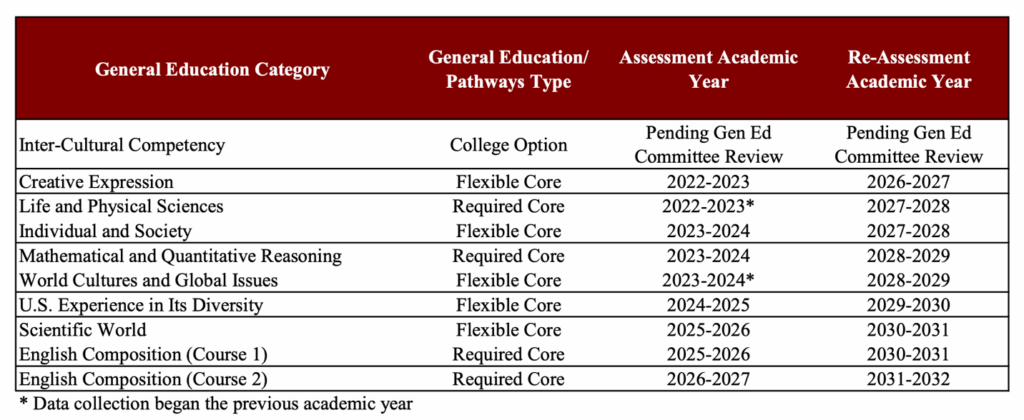
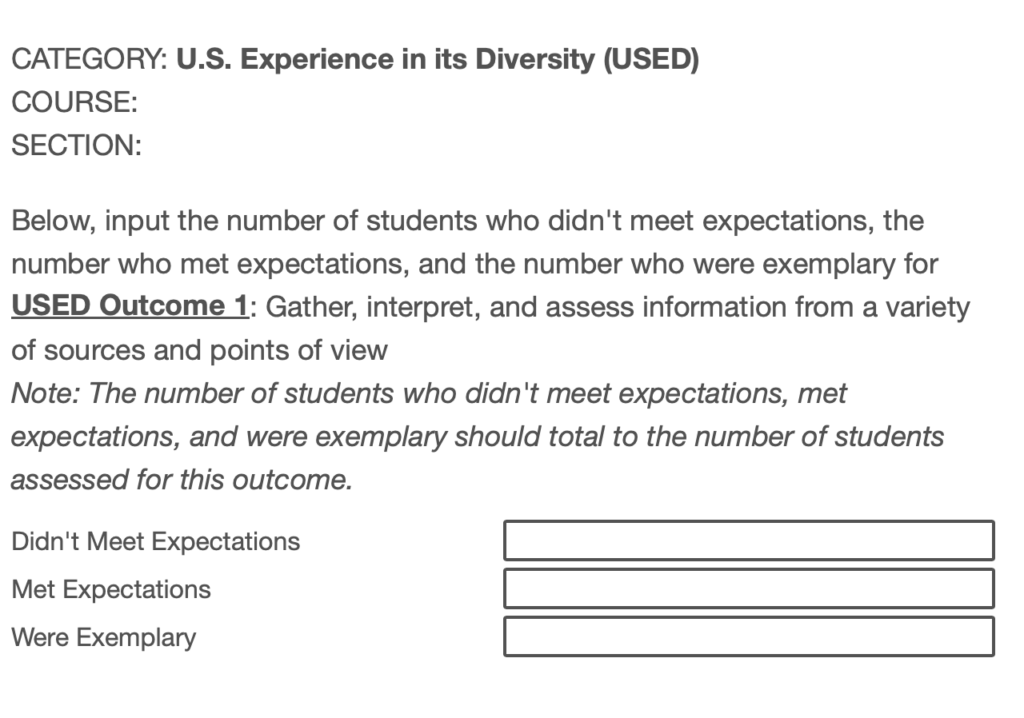
Table 1.2 – Example of Qualtrics Form for Collecting Pathways Assessment Data
Program: Applies to every program that has a distinct NYSED (New York State Education Department) code and that does not have specialized accreditation. Assessment should occur on a four to five-year cycle, depending upon the number and frequency of SLOs being assessed.
- SLOs are generated by the department. These should be revised as needed, particularly when a department’s goals, mission statement, and/or courses are amended.
- Assessment activities should be linked to senior-level courses, such as capstone or higher-level courses. The goal is to determine if students are meeting/exceeding a program’s SLOs upon graduation.
- Departments are required to submit annual program assessment reports, regardless of whether assessment data is actively being collected. The template for these forms can be found via the Program Assessment website.
Self-Study: Applies to every department in the college that does not have specialized accreditation and occurs every eight years. The self-study includes a written report and culminates in a site visit from external evaluators.
- The self-study allows a department to highlight their accomplishments and improvements. It is also documents areas in need of additional support, particularly in terms of the college’s resource allocation.
A Self Study Report template was introduced in 2024.